
AC running but not cooling: causes, safe checks and when to call for repair in Linden, NJ
When an AC is running but not cooling, the cause is almost always one of six things: a clogged air filter, a frozen indoor coil, a dirty outdoor condenser, a failed capacitor, low refrigerant from a leak, or a thermostat set wrong. You can check most of these yourself in about 20 minutes with no tools. Capacitors and refrigerant need a licensed tech with a meter and gauges.
This guide is written for Linden and the rest of Union County, where humid 90-degree afternoons and hot second-floor bedrooms push central air hard.
Key points
- The six usual causes: dirty filter, frozen coil, dirty condenser, bad capacitor, refrigerant leak and thermostat settings.
- A healthy central AC cools air 15-20°F between the return grille and a supply vent.
- Ice on the copper lines means turn cooling off and run the fan alone until the coil thaws.
- An outdoor fan that won't spin, or a unit that hums, usually means a capacitor or motor job for a tech.
- R-410A is still legal to service in New Jersey, but recharging a leaking system costs more every year.
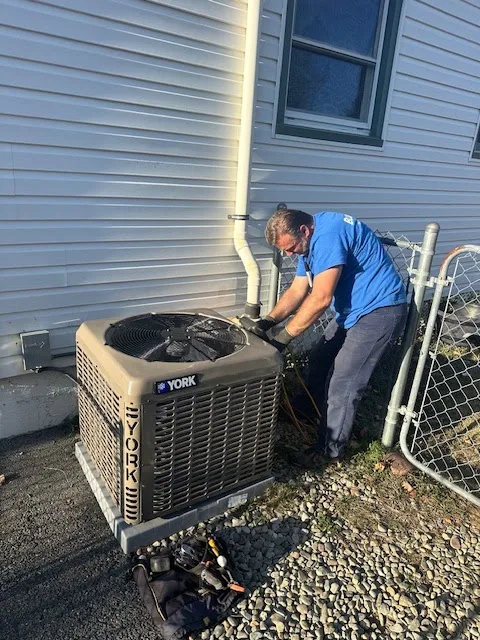
Why is my AC running but not cooling the house?
Usually air isn't moving across the coils the way it should, or the refrigerant can't carry heat out of the house. A clogged filter or dirty outdoor coil blocks airflow. A failed capacitor stops the outdoor fan or compressor. A leak leaves the system low on refrigerant, and then the indoor coil can freeze. Thermostat mistakes cover most of the rest.
The indoor evaporator coil pulls heat from the air your blower pushes across it. Refrigerant carries that heat through copper lines to the outdoor condenser, where a fan blows it into the yard. Break any link and the vents blow warm air.
Less common causes include leaky ducts in a hot attic, a system undersized from the start, and age. A central AC typically lasts 10-15 years, and an older compressor loses capacity long before it quits. If your own checks come up clean, those are the things an AC repair visit should rule in or out.
What can you safely check before calling for AC repair?
Run the six checks below in this order and stop at the first one that turns up a problem. None of them means opening a panel with live wiring inside. Plan on 20 to 30 minutes, plus a few hours if you find ice and need to thaw the coil. If you smell burning or hear loud buzzing, skip the checks, shut the system off and call.
1. Set the thermostat to COOL and AUTO
With the fan on ON, the blower runs nonstop and pushes room-temperature air through the vents whenever the outdoor unit cycles off. That feels like warm air even when nothing is broken. Set the fan to AUTO, the mode to COOL, and the temperature 3 degrees below the room reading. Replace dead batteries, and on a smart thermostat check for an eco mode or away schedule holding the setpoint up.
2. Check the breaker and the outdoor disconnect
The indoor blower and outdoor condenser sit on separate breakers. If the vents blow air but the outdoor unit is silent, look for a tripped double-pole breaker labeled AC or condenser. Reset it once. If it trips again, leave it off and call, because a second trip points to a short, a bad capacitor or a failing compressor. Then check that the disconnect box beside the outdoor unit is switched on.
3. Pull the air filter
Slide out the filter at the furnace or air handler and hold it up to a light. If no light comes through, replace it. Change 1-inch filters every 1-3 months and 4-5 inch media filters every 6-12 months, sooner with pets or a renovation. A choked filter starves the indoor coil of air, and that's the most common reason coils freeze.
4. Clear and rinse the outdoor unit with the power off
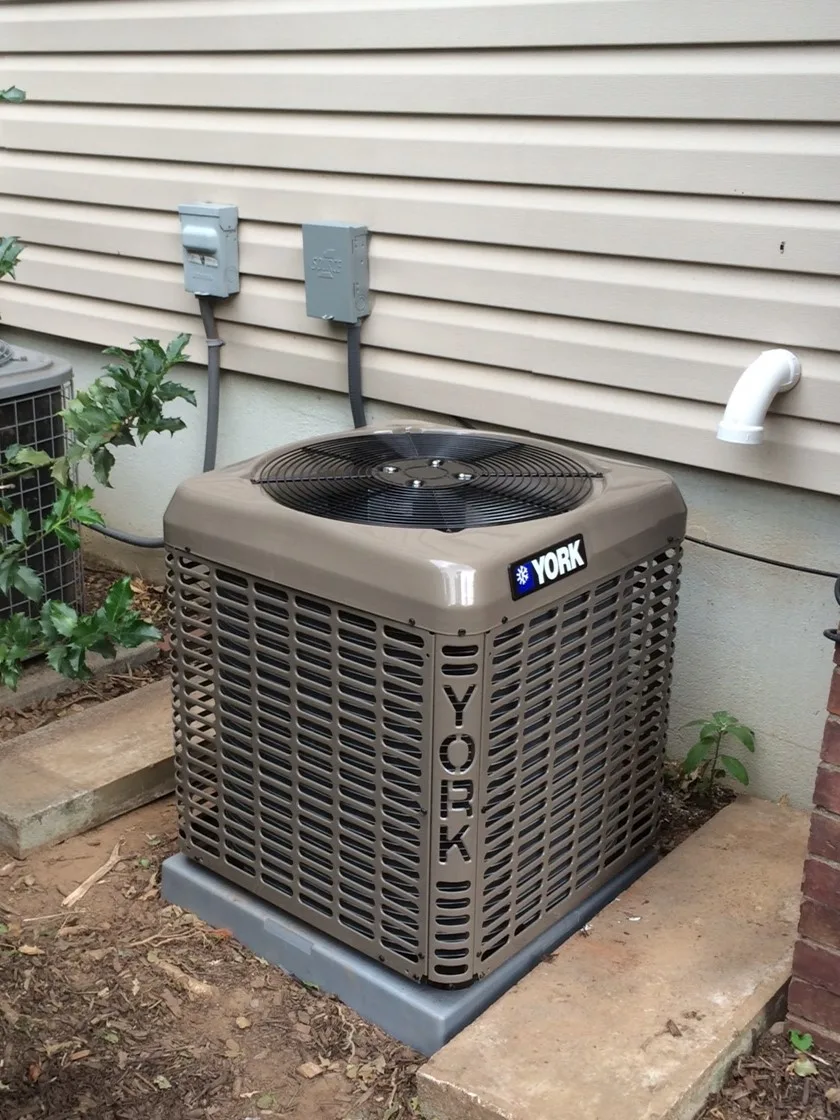
Shut off the disconnect and the breaker first. Clear two feet around the condenser: shrubs, fence boards and leaves. Rinse the fins from the outside with a garden hose on gentle spray, top to bottom. Skip the pressure washer, which folds the aluminum fins flat. Don't reach into the fan on top, and restore power when you're done.
5. Look for ice, then thaw the coil
Check the larger insulated copper line at the outdoor unit and the coil housing above the furnace. Frost or ice on either means a frozen coil. Set the thermostat to OFF and the fan to ON so the blower moves warm house air across the ice. Thawing often takes a few hours, so lay towels around the indoor unit for the melt. Never chip at the ice. If it returns within a day on a clean filter, call for service.
6. Check the condensate float switch
Many air handlers, especially attic units, have a float switch in the drain pan or on the PVC drain line. When algae clogs the line, water rises and the switch cuts the cooling call while the fan may keep running. With the power off, use a wet-dry vacuum on the outside end of the drain line, empty the pan and pour a cup of white vinegar into the access port. If it trips again within a week, the drain needs a pro.
Checked everything and still blowing warm air?
Blue Air One handles AC repair from our shop on W. Elizabeth Ave in Linden. Tell us what your checks turned up and we'll take it from there.
Call (908) 275-3953 Request service onlineHow do you tell if your AC is actually cooling?
Measure the temperature split. A working central AC typically cools air 15-20°F between the return grille, where air goes in, and a supply vent, where it comes out. Run the system on COOL for 15 minutes, then take both readings with a cheap digital probe thermometer. A split under about 10°F means part of the system isn't doing its job.
Read the main return grille, then the supply register closest to the furnace, holding the probe in the airflow for a full minute each. A 76°F return and 57°F supply is a healthy 19-degree split. A 78°F return and 70°F supply is 8 degrees, which is a problem. A low split points to low refrigerant, a weak compressor or a dirty condenser. A split well over 20 degrees usually means too little airflow. Write the numbers down for the tech.
What causes a frozen AC coil, and how do you fix it?
A coil freezes when too little warm air crosses it or the refrigerant charge is low. Dirty filters, closed supply vents, a weak blower motor and refrigerant leaks cause most of the frozen coils we see. Thawing fixes the symptom. Finding which of those four caused the ice fixes the problem, so the coil doesn't freeze again next week.
An evaporator coil normally runs around 40°F, cold enough to pull moisture from the air and warm enough that the water drips into the pan. Below 32°F, that moisture turns to frost, the frost blocks air, and less air makes the coil colder still. The real risk is the compressor, because a frozen coil can send liquid refrigerant back to a part built to pump vapor.
Which AC symptoms mean you should call a pro?
Call a licensed tech when the problem is electrical, involves refrigerant, or comes back after your checks. An outdoor fan that won't spin, a humming condenser, ice that returns within a day, hissing near the copper lines, or a system that turns on and off every few minutes all need meters, gauges and an EPA-certified technician.
| Symptom | Likely cause | DIY or call a pro |
|---|---|---|
| Vents blow room-temperature air between cycles | Thermostat fan set to ON | DIY: set the fan to AUTO |
| Indoor fan runs, outdoor unit silent | Tripped breaker, pulled disconnect or bad contactor | DIY: reset once; call if it trips again |
| Weak airflow and frost on the coil | Clogged filter | DIY: new filter, then thaw |
| Ice returns after a new filter | Low refrigerant or blower problem | Call a pro |
| Outdoor fan won't spin, unit hums | Failed capacitor or fan motor | Call a pro; power off |
| Hissing near the lines | Refrigerant leak | Call a pro |
| Cooling stops, water in the pan | Clogged condensate line, float switch tripped | DIY: clear the line; call if it repeats |
| Turns on and off every few minutes | Oversized unit, low charge or thermostat location | Call a pro |
| Upstairs much warmer than downstairs | Duct layout, single return, attic heat | Call for a duct evaluation |
The outdoor fan won't spin or the unit hums
A hum with the top fan sitting still usually means a failed run capacitor, a stuck contactor or a worn fan motor. A capacitor holds a charge after the power is off and can shock you badly, so leave it to a tech. Turn the unit off at the disconnect so the compressor doesn't overheat straining against a dead capacitor.
Hissing or short cycling
Hissing at the copper lines or oily residue on a joint points to a refrigerant leak, and only an EPA Section 608 certified technician can handle refrigerant. A system that runs three or four minutes, stops and starts again is short cycling, from an oversized unit, low charge or a thermostat sitting in afternoon sun.
Why does your AC struggle on 90-degree NJ days?
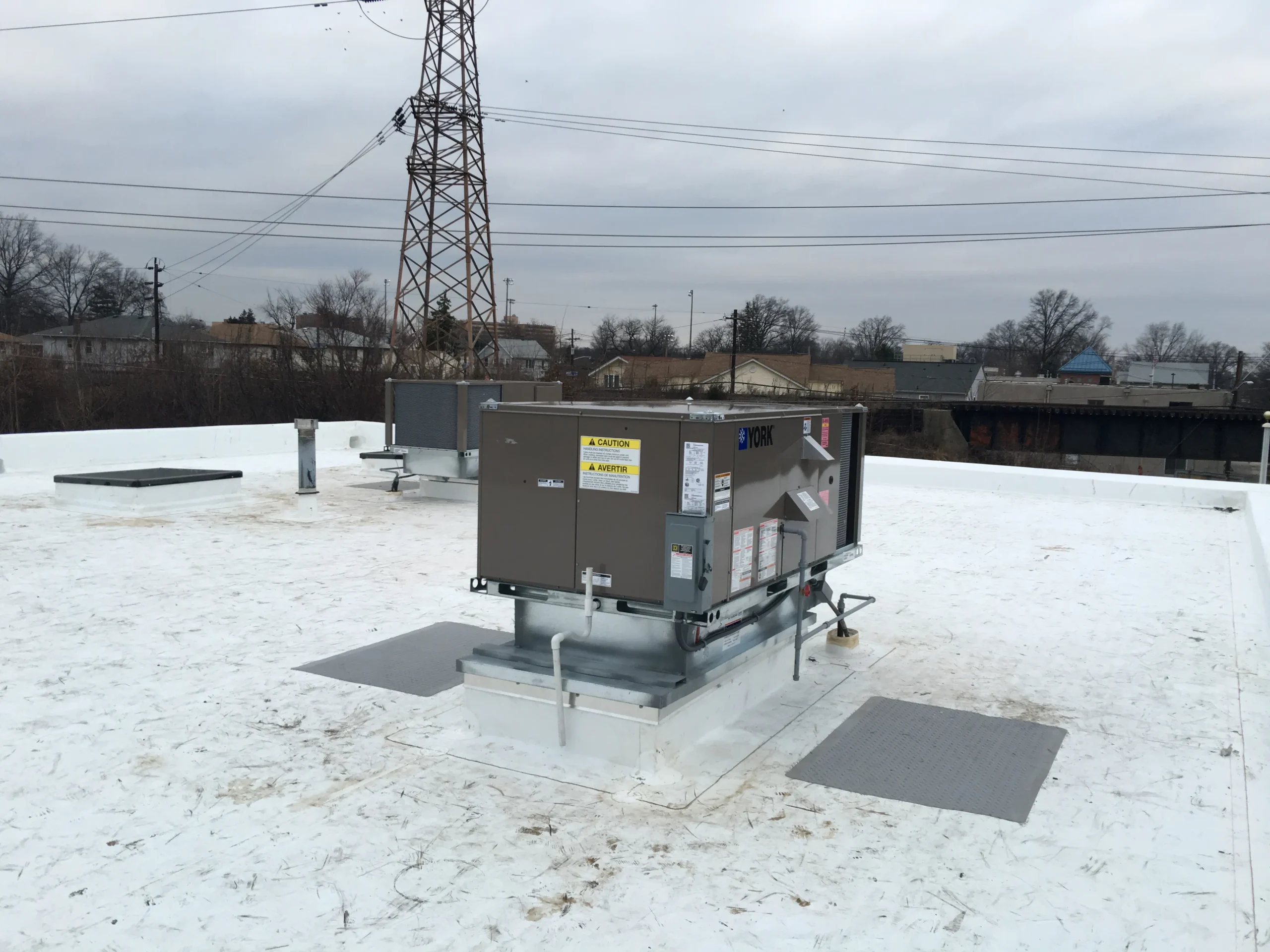
Central air in New Jersey is sized for a design day in the low 90s, so on a 95°F humid afternoon it may run nonstop and still let the house drift a few degrees above the setpoint. That's normal if the temperature split stays at 15-20°F. It's a repair problem when the split drops or the house can't catch up overnight.
Humidity eats capacity, since your AC spends part of its work pulling water from the air. Setting the thermostat to 65 won't cool faster, because a single-stage system has one speed. Pick a setting and leave it.
Second-floor bedrooms in Cape Cods and colonials
Cape Cods are common across Linden and Cranford. Their upstairs rooms have knee walls and sloped ceilings with attic space behind the drywall, and the ducts often run through that hot attic. Colonials in towns like Westfield push air up long wall runs from a basement furnace, and many older New Jersey homes have one central return at the bottom of the stairs, so hot upstairs air has nowhere to go.
A 2026 NJ cost guide puts an added return air drop at $500-$1,000 per return. For a Cape Cod with a stubborn top floor, a ductless mini-split upstairs is often the cleanest fix.
Is low refrigerant the cause, and does R-410A matter?
Low refrigerant always means a leak, because an AC doesn't use refrigerant up. Most NJ systems installed before 2025 run on R-410A, which is still legal to service. Manufacturing of new R-410A split systems stopped January 1, 2025, and supply is shrinking under the federal HFC phasedown, so recharges keep getting pricier.
A tech confirms the charge with gauges and finds the leak before recharging. On May 21, 2026, the EPA finalized changes removing the January 1, 2026 installation deadline for leftover R-410A equipment. New systems use R-454B or R-32, and neither works with an R-410A indoor coil. Our post on the R-410A phase-out for NJ homeowners covers the repair-or-replace call on an older system.

Should you repair or replace an AC that won't cool?
Repair it when the system is under about 10 years old and the problem is a capacitor, contactor, filter, drain or one findable leak. Consider replacement when a central AC is 12-15 years old, needs a compressor or coil, or leaks R-410A every summer. In New Jersey, central AC replacement typically runs $4,500-$10,000 with existing ducts.
That range comes from HVACProjectCost's 2026 New Jersey guide. Your real number depends on a site visit, a load calculation and duct condition. The federal 25C credit ended for equipment installed after December 31, 2025. Our 2026 NJ HVAC replacement cost guide breaks prices down by system, and the older repair vs. replacement guide covers the age-and-cost math.
Don't let anyone sell you a full system for a capacitor. Craig M. wrote in his Google review: "Everyone else tried to sell me an entirely new HVAC system and other things I didn't need." He did need a new AC during a heat wave, and "the work was done the next day." If replacement wins, compare AC installation quotes and our financing options.
How does regular maintenance keep your AC cooling?
Most failures here start small: a filter left three months too long, a condenser packed with cottonwood, an algae-filled drain, a capacitor drifting out of spec. A spring tune-up catches them before the first 90°F week. The tech cleans the coils, tests the capacitor and contactor, checks refrigerant pressures and flushes the condensate drain.
Book AC maintenance in April or May, before the first heat wave fills every Union County HVAC schedule.
What to do next if your AC is blowing warm air in Linden
Run the six checks, measure the temperature split, and write down what you found before you call. If the breaker trips twice, the outdoor fan won't spin, the unit hums, you hear hissing, or ice returns after a thaw, shut the system off and schedule AC repair. A struggling compressor left running can turn a capacitor job into a replacement.
- Note the thermostat setting, your temperature split and what the outdoor unit is doing.
- If you see ice or hear humming, set the thermostat to OFF and run the fan alone.
- Read the outdoor unit's nameplate for the model number, refrigerant type and manufacture date.
- Call or book a service visit online, and mention rooms that run hotter than the rest.
Blue Air One is a family-owned company founded by Marcel Majernik in 2007, based at 508 W. Elizabeth Ave in Linden under NJ HVAC license NJ19HC00122900. We work on York, Goodman, Friedrich and the other major brands, and we take emergency calls across Union County and nearby Edison and Woodbridge.
AC running but not cooling in Union County?
Call Blue Air One with your temperature split and what the outdoor unit is doing. We'll diagnose it and give you the repair and replacement options in plain numbers.
Call (908) 275-3953 Request service onlineFrequently asked questions about AC that won't cool
Why is my AC running but the house isn't cooling down?
The most common causes are a clogged air filter, a frozen evaporator coil, a dirty outdoor condenser, a failed capacitor, low refrigerant from a leak, and the thermostat fan set to ON. Check the thermostat, breaker, filter and outdoor unit first. If those look fine and the temperature split is under 10°F, call a technician.
How long does it take a frozen AC coil to thaw?
Usually a few hours with the thermostat set to OFF and the fan set to ON, so the blower moves warm house air across the ice. A heavily iced coil can take most of a day. Keep towels near the indoor unit for the melt, and don't restart cooling until the copper suction line is dry.
Is it normal for my AC to fall behind during a New Jersey heat wave?
Yes, within limits. Most NJ systems are sized for a design day in the low 90s, so on a 95°F humid afternoon the house may drift a few degrees above the setpoint while the AC runs nonstop. If the split stays at 15-20°F and the house recovers overnight, it's working as designed.
How much does it cost to recharge an AC in NJ?
It depends on how many pounds the system needs and the current price of R-410A, which keeps rising as federal supply shrinks. Low refrigerant always means a leak, so a recharge alone is money spent twice. Ask the technician to price the leak repair and the recharge separately so you can compare.
Why is my upstairs so hot when the AC is running?
In many Cape Cods and colonials, upstairs ducts run through a hot attic or long wall runs, often with one central return downstairs. Fixes include sealing attic ducts, adjusting dampers, adding an upstairs return air drop at about $500-$1,000 per return, or installing a ductless mini-split for the top floor.
Should I turn off my AC if it's not cooling?
Turn it off if you see ice on the copper lines, hear humming from the outdoor unit, or the breaker trips twice. Running a frozen or struggling system can damage the compressor, the most expensive part of an AC. Set the thermostat to OFF, run the fan alone if there's ice, and call for service.
