
Boiler vs furnace in older NJ homes: how to heat and cool a radiator house
If your house has radiators or baseboard heat and the system works, replace the boiler with another boiler. Switching an older New Jersey home to a furnace means building a duct system through plaster walls, closets and the attic, and that construction often costs more than the furnace. The boiler vs furnace question only tilts toward a furnace when the house already has ducts or you're gutting it. Below we cover steam and hot water systems, comfort, Elizabethtown Gas rebates, adding central air and the signs a boiler is near the end.
Key points
- Boiler to boiler keeps your radiators and pipes; boiler to furnace means new ductwork.
- Boilers typically last 20-30 years, gas furnaces typically 15-20.
- Elizabethtown Gas pays $900 or $1,000 for a condensing boiler and $1,300 or $1,750 for a condensing combi.
- An indirect water heater paired with a 90%+ boiler earns another $250 from ETG.
- Central air in a radiator house comes from attic ducts, small-duct high-velocity systems or ductless mini-splits.

Should an older NJ house keep its boiler or switch to a furnace?
Keep the boiler in most cases. A house built around radiators has no supply ducts and no return air path, so a furnace would need a full duct system cut into walls, floors and closets before it heats a single room. A new boiler connects to the piping you already have, and cast iron radiators can outlast several boilers.
Many prewar Colonials and Cape Cods in Union County have had cast iron radiators or hydronic baseboard from day one. We see them constantly in Cranford homes and in Westfield's prewar neighborhoods, where the radiators are sized for the rooms and the pipes are already in the walls.
A furnace makes sense when the house already has ductwork, or you're doing a gut renovation with open walls. Otherwise a new boiler installation is the cheaper, less disruptive path. We lay out both options and you make the call.
How do a boiler and a furnace heat a house?
A boiler heats water, or turns it into steam, and sends it through pipes to radiators, baseboard or radiant floor tubing. The metal warms the room by radiation and convection. A furnace burns gas to heat a metal heat exchanger, and a blower pushes air across it and through ducts to registers, then pulls it back through return grilles.
Inside a boiler system
A hot water boiler has a burner, a water-filled heat exchanger, a circulator pump that moves water through the loop, and an expansion tank that absorbs the pressure rise as the water heats. Zone valves or separate pumps let each floor run on its own thermostat.
Inside a furnace system
A gas furnace has a burner, heat exchanger, blower and filter slot. A 90%+ AFUE furnace vents through PVC and makes condensate, so it needs a drain or pump. The same blower and ducts carry cold air in summer when an AC coil sits on top, which is why furnaces dominate newer NJ construction.
Steam vs hot water boiler: which one do you have?
Check the boiler itself. A steam boiler has a sight glass, a small glass tube showing the water level, and a pressure gauge that reads very low, usually under 2 psi in a house. A hot water boiler has a combined pressure and temperature gauge, an expansion tank nearby and a circulator pump on the piping.
The radiators give clues too. One-pipe steam radiators have a single pipe at the bottom and a small air vent that hisses as the system heats. Hot water radiators have two pipes plus a bleed valve near the top. Baseboard fin-tube heat is almost always hot water.
What steam means for replacement
Steam is common in the oldest homes in Linden, Cranford and Westfield. Steam boilers don't condense, so they can't reach the 90%+ efficiency of a condensing hot water boiler, and a steam-to-steam swap won't qualify for the Elizabethtown Gas condensing tiers. Converting to hot water usually means repiping, so most steam homes stay with steam. A properly sized steam boiler with working vents still heats evenly.

How does boiler heat feel compared to forced air?
Boiler heat is slow to start and steady once it's running. Cast iron radiators hold heat and keep warming the room after the burner shuts off, so temperatures swing less. Forced air warms a room in minutes, but the room cools quickly once the blower stops, and you can feel drafts near the registers.
Humidity and dry air
Forced air tends to feel drier in a New Jersey January because air keeps moving across your skin and leaky ducts pull in dry outdoor air. A furnace can take a whole-house humidifier on the ductwork, while boiler homes rely on standalone units. Our indoor air quality services cover both.
Noise and dust
A hot water system is close to silent apart from a faint pump hum. Steam can bang when condensate pools in a pipe that has lost its pitch, which is fixable. A furnace makes blower noise, and ducts can pop as they heat. Radiators don't blow dust around, but they don't filter anything either, while a furnace filter does if you change it on schedule.
Boiler vs furnace: side-by-side comparison
The biggest differences are how heat reaches the rooms, how long the equipment lasts and whether it can share ducts with central air. Boilers typically outlast furnaces by five to ten years, while furnaces win on air conditioning because the coil and blower share one duct system. Elizabethtown Gas rebates cover condensing versions of both.
| Factor | Boiler | Furnace |
|---|---|---|
| Heat delivery | Hot water or steam through pipes to radiators, baseboard or radiant floors | Heated air pushed through ducts to registers by a blower |
| Typical lifespan | 20-30 years | 15-20 years |
| Warm-up speed | Slower start, steady heat that lingers | Fast warm-up, cools quickly when off |
| AC compatibility | None built in; needs separate ducts, high-velocity tubes or mini-splits | Shares ducts and blower with a central AC coil |
| ETG rebate (non-condensing to condensing) | $900 at 90-94.99% AFUE, $1,000 at 95%+; combi $1,300 at 95%+, $1,750 at 97%+ | $900 at 95%+ AFUE |
| Best for | Older homes with radiators or baseboard already in place | Homes with existing ducts or a gut renovation |
A Cranford Colonial with working radiators points to a boiler. A Linden split-level with ducts points to a furnace. The hard calls are radiator houses with attic ducts already feeding central AC upstairs.
Not sure whether to keep the boiler?
We'll look at your boiler, piping and radiators, tell you what each option involves, and let you decide.
Call (908) 275-3953 Request service onlineWhat do condensing and combi boilers offer NJ homeowners?
A condensing boiler pulls extra heat out of its exhaust by cooling the flue gas until water vapor condenses, which lets it reach 90% AFUE or higher. Elizabethtown Gas pays $900 for a 90-94.99% AFUE boiler and $1,000 for 95%+ when it replaces a non-condensing boiler. Condensing combi boilers earn $1,300 or $1,750.
Condensing boilers work best when water returning from the radiators is cool enough to condense the flue gas. Baseboard and large cast iron radiators allow lower water temperatures on mild days, especially with an outdoor reset control, and ETG offers a smaller rebate for boiler reset controls. Condensing boilers vent through PVC or polypropylene and need a condensate drain.
Combi boilers in NJ homes
A combi boiler heats the house and makes hot water on demand in one wall-hung cabinet with no tank. Combis suit homes with one or two bathrooms. In a larger Westfield house where two showers run at once, a condensing boiler with an indirect-fired tank keeps up better, and ETG adds $250 for that tank when it's paired with a 90%+ boiler.
ETG rebate rules to know before you buy
- Condensing to condensing replacements don't qualify.
- The boiler must be selected by Manual S from a Manual J load calculation.
- You need the AHRI certificate, invoice and a photo of the old unit, and you apply within 120 days of purchase.
- Low-to-moderate income households can get an extra $300 per qualifying item.
The program can change without notice, so read the current Elizabethtown Gas rebate application. The federal 25C credit ended for equipment placed in service after December 31, 2025, per the IRS credit page, so a 2026 boiler gets no federal credit.
Burnham and Slant Fin boilers
Blue Air One services Burnham and Slant Fin boilers, two brands found in plenty of Union County basements. If yours is acting up, a repair may buy several more seasons.
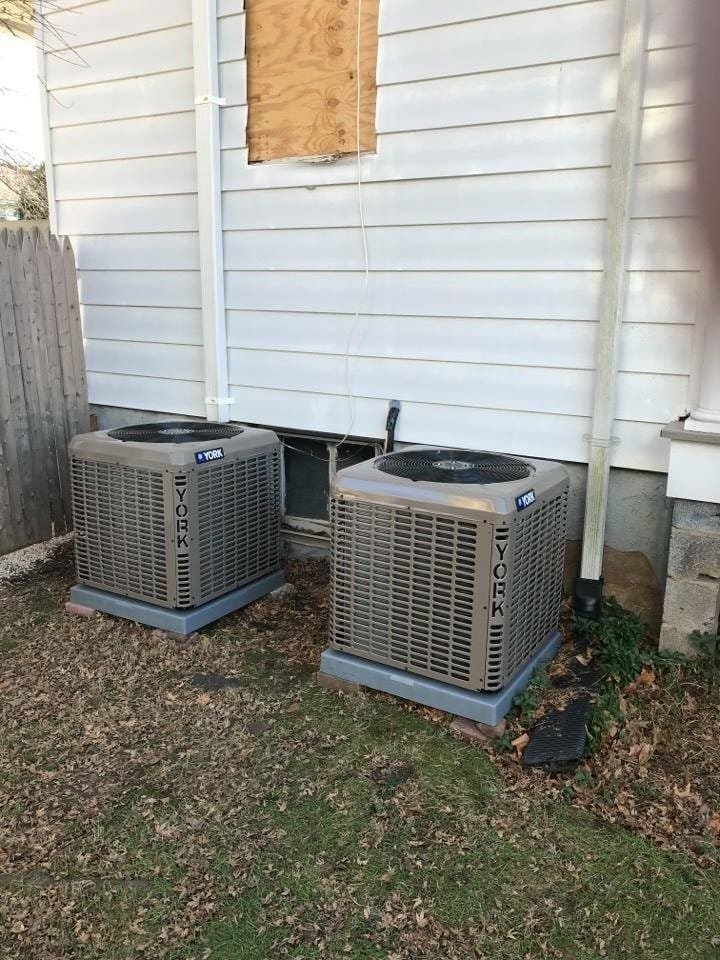
How do you add central air to a house with radiators?
Keep the boiler for heat and add cooling separately. There are three ways to do it: conventional ducts with an air handler in the attic, a small-duct high-velocity system that snakes flexible tubing through closets and walls, or ductless mini-splits with a wall-mounted head in each room. The right one depends on attic access and how many floors need cooling.
Attic air handler with conventional ducts
An attic air handler with ducts dropping into second-floor ceilings is the classic fix for Colonials and Capes. The first floor is harder, since ducts have to come down through closets, and a return air drop costs about $500-$1,000 per return. Our central AC installation team designs these from a load calculation.
Small-duct high-velocity systems
High-velocity systems use small flexible tubes and round outlets, so they fit where standard ducts can't and need less plaster demolition. The outlets make a soft rushing sound, and the system costs more per ton than conventional ducts.
Ductless mini-splits
Mini-splits run refrigerant lines from one outdoor unit to heads in individual rooms. They're heat pumps, so they also heat on mild days. PSE&G offers instant rebates on qualifying mini-splits, and JCP&L lists up to $750. Read our older post on ductless mini-split installation and our heat pump vs gas furnace comparison for NJ winters if you're thinking about heat pumps for more than cooling.
What are the signs a boiler is failing?
Water on the floor, rumbling or kettling sounds, a dripping pressure relief valve, radiators heating unevenly and pilot or ignition trouble are the common warnings. Age matters too. A boiler past 20 years with any of these problems is a candidate for replacement rather than another repair, especially if parts are getting hard to find.
- Leaks: a leaking valve or fitting is fixable; a cracked heat exchanger usually means replacement.
- Kettling: a rumbling, tea-kettle sound comes from scale on the heat exchanger.
- Relief valve dripping: pressure is climbing too high, often from a waterlogged expansion tank or failing fill valve.
- Uneven radiators: cold tops mean trapped air; a whole cold zone points to a stuck zone valve or failed circulator.
- Pilot problems: a pilot that won't stay lit often has a bad thermocouple.
Most of these are heating repair calls, not replacements. If you smell gas, leave the house and call Elizabethtown Gas's emergency line or 911 from outside. New Jersey requires carbon monoxide alarms in homes with fuel-burning appliances, so test yours when the heat comes on.
How do you maintain a boiler between service calls?
Bleed hot water radiators at the start of the season, keep an eye on system pressure, check the steam sight glass if you have steam, and book a professional service once a year before the cold sets in. Most hot water systems in houses run about 12-15 psi cold and should stay well under the relief valve's rating when hot.
- Bleeding radiators: with the system warm, open each bleed valve with a radiator key until water replaces the hissing air.
- Pressure: check the gauge after bleeding, since removing air can drop pressure.
- Steam water level: the sight glass should read about half full while the boiler is idle.
An annual tune-up covers a combustion and carbon monoxide test, burner cleaning, and checks on the expansion tank, circulator, relief valve, low water cutoff and venting. Book heating maintenance in early fall, and see our seasonal HVAC maintenance guide for Cranford for the full calendar.

How much does a boiler replacement or furnace conversion cost in NJ?
The answer depends on whether you keep your radiators. A gas furnace replacement in NJ runs $3,500-$8,500, but that range assumes the ducts already exist. Converting a radiator house to a furnace adds a full duct system, returns and wall repairs. A boiler-to-boiler swap reuses the piping, and an ETG rebate of up to $1,750 offsets part of the cost.
Full HVAC replacements in New Jersey run $5,000 to $17,000, and a furnace plus central AC with a new coil and air handler lands at $8,500-$17,000. North Jersey labor runs 15-20% above the state average. Boiler pricing swings with size, steam vs hot water and venting, so we price it after a site visit and heat loss calculation. Our 2026 NJ HVAC replacement cost guide breaks down the furnace and AC numbers.
Tucker M. summed up what we aim for in a quote: "Transparent pricing and no add on fees." If the number is more than you want to pay at once, look at our residential financing options before you settle for a smaller repair.
What to do next if your boiler is getting old
Start by finding the boiler's data plate for the model and age, then note whether it's steam or hot water and which rooms run cold. With that, a contractor can tell you in one visit whether repair, a new boiler or a switch to forced air fits your house, and which ETG rebate applies.
- Photograph the data plate and gauges; ETG requires a photo of the old unit.
- List cold rooms, banging pipes and any water around the boiler.
- Decide whether you also want central air this year.
We're based on West Elizabeth Avenue in Linden, handling heating and cooling across Union County. Contact Blue Air One to set up a visit.
Get a straight answer on your boiler
Repair, new boiler or a switch to forced air: we'll inspect your system and price each option for your house.
Call (908) 275-3953 Request service onlineFrequently asked questions about boilers and furnaces
Is it worth replacing a boiler with a furnace in NJ?
Usually not in a house built around radiators. A furnace needs supply ducts and returns, and adding them to an older home means opening walls, ceilings and closets. That cost often tops the furnace price. A switch makes sense if the house already has ducts, you're gutting it, or you want one system for heat and central air.
How long does a boiler last?
A well-maintained boiler typically lasts 20-30 years, longer than the 15-20 years most gas furnaces get. Cast iron boilers often reach the top of that range. Lifespan drops with neglected water chemistry, scale buildup and skipped service. Once a boiler passes 20 years and starts leaking or needing major parts, replacement usually costs less over time.
Can you add central air to a house with radiators?
Yes. Most homeowners keep the boiler for heat and add cooling with an attic air handler and conventional ducts, a small-duct high-velocity system, or ductless mini-splits. Attic systems cool the second floor easily. High-velocity tubing fits tight plaster walls. Mini-splits need no ducts at all and also heat on mild days.
What is the difference between a steam and hot water boiler?
A steam boiler boils water and sends steam to the radiators at low pressure, usually under 2 psi in a house. A hot water boiler heats water without boiling it and pumps it through a closed loop. Steam systems have a sight glass and one-pipe radiators with air vents. Hot water systems have an expansion tank and circulator.
Does Elizabethtown Gas give rebates for new boilers?
Yes, when you replace a non-condensing boiler with a condensing one. ETG pays $900 for 90-94.99% AFUE and $1,000 for 95%+. Condensing combi boilers get $1,300 at 95%+ and $1,750 at 97%+. An indirect water heater paired with a 90%+ boiler adds $250. Apply within 120 days of purchase.
Is a combi boiler a good idea in NJ?
A combi boiler works well in smaller homes with one or two bathrooms, since it heats the house and makes hot water on demand without a tank. It saves basement space and qualifies for a $1,300 or $1,750 ETG rebate. Larger homes with several showers running at once often do better with a boiler and an indirect tank.
Why is my boiler pressure relief valve leaking?
The relief valve opens when system pressure climbs past its rating. The usual causes are a waterlogged expansion tank that can no longer absorb expansion, a fill valve letting in too much water, or a worn relief valve. Don't cap or plug it. Call for a heating repair, because high pressure in a boiler is a safety issue.
